Do Sole Traders Pay Corporation Tax? UK Rules Explained

.png)
Composed by Taxara on
10/7/2026
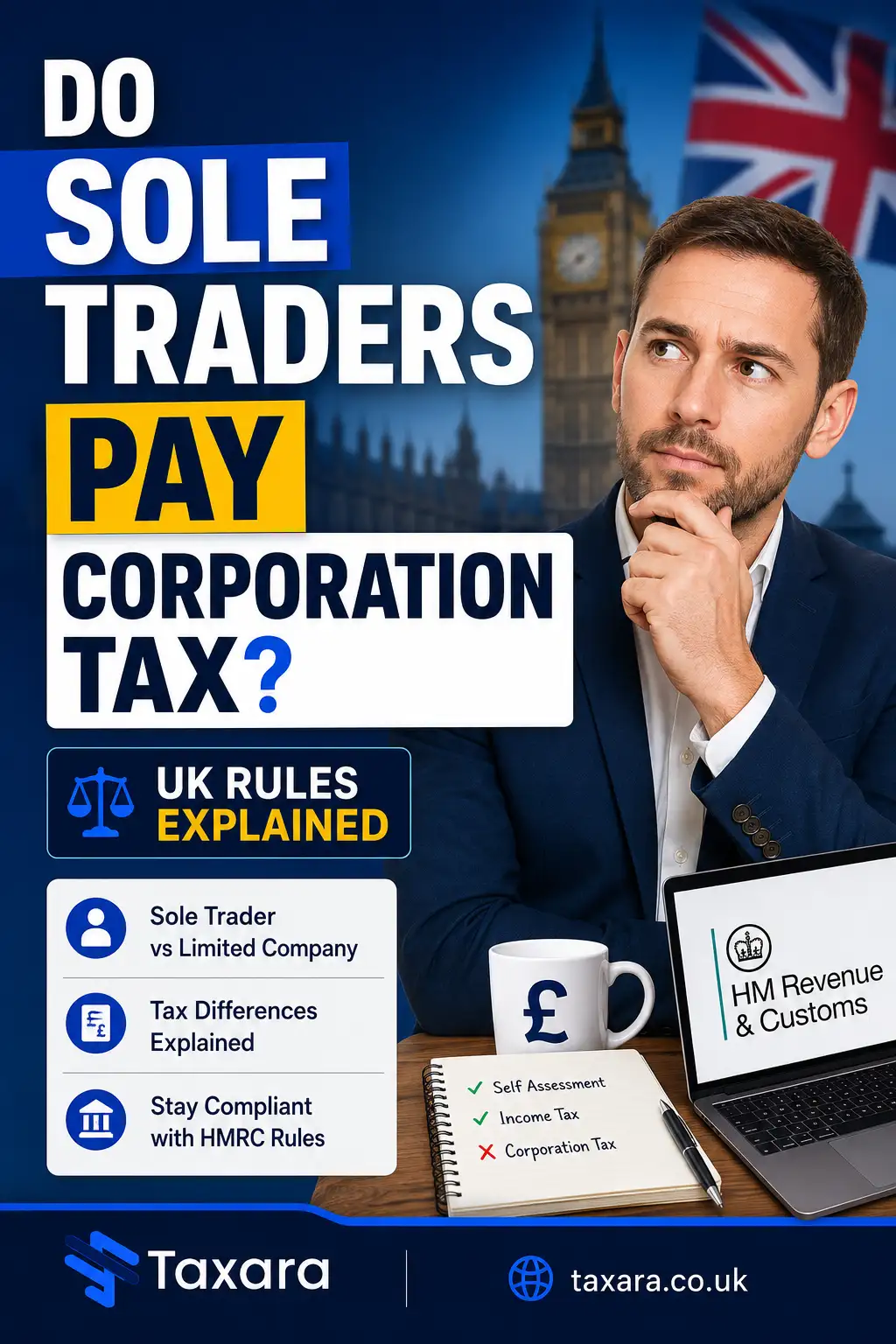
Short answer: no. Sole traders in the UK do not pay corporation tax. Corporation tax is charged on limited companies, not on individuals trading in their own name. If you run your business as a sole trader, your profits are taxed through Income Tax and Class 4 National Insurance, both reported on your Self Assessment return.
That single distinction trips up a lot of people searching this exact question, so it's worth being precise about why.
Why the confusion happens
Corporation tax and income tax are built for two different legal setups. A limited company is a separate legal entity from the person running it. The company earns the profit, the company pays corporation tax on it, and then the owner takes money out as salary or dividends, which get taxed again on a personal level.
A sole trader isn't separate from their business. There's no company sitting between you and HMRC. You and the business are the same legal person, so HMRC taxes you directly on your trading profit, the same way it would tax any other income you earn.
That's the whole answer, really. No company, no corporation tax.
If you'd rather not track all of this by hand, a sole trader tax app like Taxara can work out your Income Tax and Class 4 NI as you go, so there are no surprises at Self Assessment time.
What sole traders pay instead
Sole trader profit is taxed in two parts each year:
Income Tax, at the same rates as employees:
- 0% on the first £12,570 (your Personal Allowance)
- 20% on profit between £12,571 and £50,270
- 40% on profit between £50,271 and £125,140
- 45% on profit above £125,140
Class 4 National Insurance:
- 6% on profits between £12,570 and £50,270
- 2% on profits above £50,270
There's also Class 2 National Insurance, though this stopped being a compulsory weekly charge from April 2024. If your profits sit below the Small Profits Threshold (£7,105 for 2026/27), you can pay it voluntarily at £3.65 a week to keep your State Pension record intact. Above that threshold, you get the qualifying year automatically, no payment needed.
Both of these are calculated on your profit, not your turnover, so what you can deduct before tax matters. If you haven't gone through your allowable expenses as a sole trader recently, it's worth a look before you estimate your bill, since it directly changes the profit figure these rates apply to.
Both income tax and Class 4 NI are worked out and paid through the same Self Assessment return, due by 31 January after the end of the tax year.
A worked example
Say your sole trader profit for the year is £40,000.
- Personal Allowance covers the first £12,570, tax free.
- The remaining £27,430 is taxed at 20%, giving £5,486 in Income Tax.
- Class 4 NI applies to the same £27,430 at 6%, giving £1,645.80.
Total tax and NI owed: roughly £7,132. No corporation tax appears anywhere in that calculation, because there's no company involved.
When corporation tax would actually apply to you
You'd only start paying corporation tax if you stopped being a sole trader and formed a limited company instead. At that point:
- The company pays corporation tax on its profits: 19% up to £50,000, 25% above £250,000, with marginal relief tapering the rate in between.
- You then pay separate personal tax on whatever salary or dividends you draw from the company.
This is why "sole trader vs limited company" is a genuinely different question from "do sole traders pay corporation tax." The two structures aren't taxed the same way, and switching from one to the other changes which taxes apply to you, not just the rates. We've broken down the full comparison, including when incorporating actually pays off, in sole trader vs limited company: which pays less tax.
Does registering as self-employed change anything?
No. Registering with HMRC as self-employed, getting a Unique Taxpayer Reference, filing Self Assessment: none of it creates a company, and none of it brings corporation tax into the picture. You remain personally liable for Income Tax and Class 4 NI on your profits, exactly as described above, for as long as you trade as a sole trader.
One thing that is changing, though, is how you report those profits. If your combined income crosses the threshold, Making Tax Digital for Income Tax brings quarterly digital reporting into the mix from April 2026.
The bottom line
If you're self-employed and trading under your own name, corporation tax simply doesn't apply to you. Your tax bill is Income Tax plus Class 4 National Insurance on your profit, filed once a year through Self Assessment. Corporation tax only enters the picture if you incorporate and start trading through a limited company, and even then, it's the company that pays it, not you personally.
If you're weighing up whether incorporating would actually save you money at your profit level, that comparison depends on your numbers rather than a general rule, and it's worth running the figures for your specific situation before deciding either way.
Whichever way you're structured, HMRC's reporting requirements are shifting regardless. Our Making Tax Digital checklist for the self-employed covers what to have in place before quarterly reporting becomes mandatory for you.
Reviewed against HMRC's published Income Tax, National Insurance, and Corporation Tax rates for the 2026/27 tax year. Rules and thresholds can change with future Budgets, so always check current rates on GOV.UK or with a qualified accountant before filing.
Never stress again
Never be late again
Never waste time
.png)

On time.
In shape.
Taxara keeps your finances in shape and always on time - with just a few simple taps and clicks.
Try for free
Simple.
Affordable.
Taxara comes with a free plan, and the premium one starts from £6.99 - about the same as your daily coffee.
Try for free
Your time.
All yours.
Win back your time and focus on what you love most - let Taxara’s AI take care of the rest.
Try for freeGot questions?

Save time for what matters most - with Taxara
Taxara Ltd. 273/275 Wilmslow Road, Manchester, England
info@taxara.co.uk
support@taxara.co.uk
.png)
.png)
.png)


.png)