Allowable Expenses for Sole Traders: The Complete List

.png)
Composed by Taxara on
22/6/2026
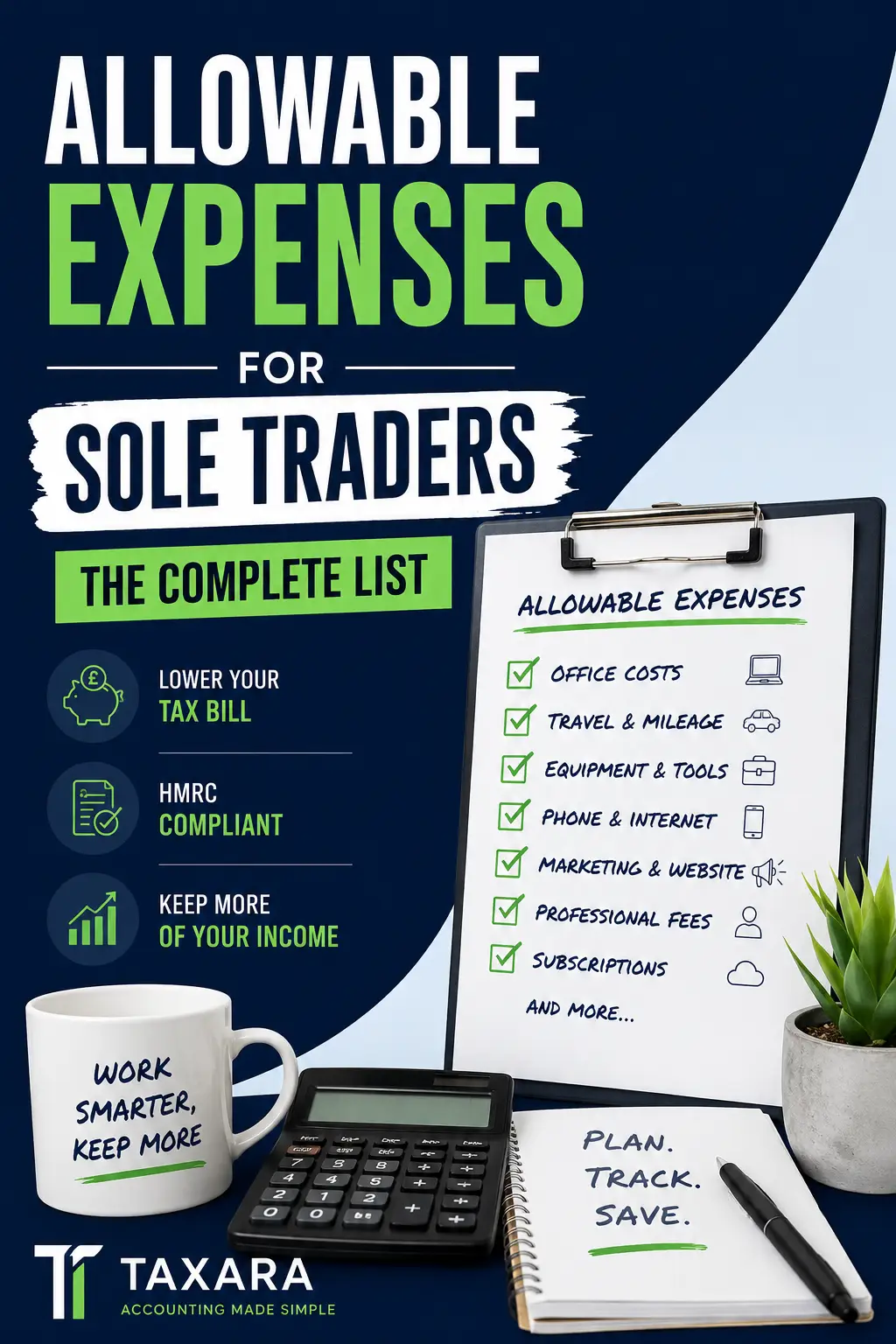
Running your own business means every receipt matters, but most sole traders only claim a fraction of what they're entitled to. Either they don't know an expense qualifies, or they're too nervous about getting it wrong with HMRC. That second guessing costs money every tax year. If you're managing your books on Taxara, this list should give you the full picture so nothing slips through.
What Counts as an Allowable Expense?
HMRC's rule sounds simple: an expense is allowable if it's "wholly and exclusively" for business purposes. In practice it gets messy fast. A laptop you use for client work and Netflix isn't wholly business. A train ticket to a client meeting is. The line between the two trips people up constantly, especially with home and travel costs, which we'll get into below.
Claiming these expenses reduces your taxable profit, not your tax bill directly. So if you earned £30,000 and claimed £5,000 in expenses, you're taxed on £25,000. Every legitimate expense you miss is profit you're paying tax on for nothing.
Office and Home Working Costs
If you work from home, even part time, you can claim a portion of your household bills. HMRC gives you two routes here.
The simplified flat rate uses fixed monthly amounts based on hours worked from home: £10 a month for 25 to 50 hours, £18 for 51 to 100 hours, and £26 for 101 or more. No receipts needed, no calculations, just pick the bracket.
The actual cost method is more work but often pays off if your home office takes up a decent chunk of your house. You work out the business proportion of rent or mortgage interest, council tax, utilities, and insurance based on the number of rooms used and hours worked. If you've ever wondered what expenses can UK sole traders claim beyond the obvious, this is usually the biggest one people underclaim.
Either way, keep a simple log of your working hours. HMRC has asked for this during checks before, and "I just estimated" doesn't go down well.
Travel and Vehicle Expenses
Commuting to a regular workplace doesn't count, that's personal travel in HMRC's eyes. But travel to clients, suppliers, temporary work sites, or networking events is fair game.
For vehicles, most sole traders use mileage rates rather than tracking every fuel receipt and service bill. The rate is 45p per mile for the first 10,000 business miles in a tax year, dropping to 25p after that. It covers fuel, insurance, repairs, and depreciation all in one, which makes record keeping a lot simpler.
If you use public transport for business trips, train tickets, bus fares, and even the occasional taxi when it's reasonable for the circumstances are all claimable. Keep digital copies of tickets and receipts. Paper receipts fade, and once they do, you're stuck with nothing.
Hotel stays and meals when travelling for business overnight are also allowable, though meals need to stay reasonable. HMRC isn't going to argue over a £15 dinner, but a £200 tasting menu every night might raise a question or two.
Equipment, Software, and Subscriptions
This is where a lot of self employed people leave money on the table. Computers, printers, phones, and office furniture used for your business are allowable, either claimed in full as a one off expense or through capital allowances depending on the cost and how you use them.
Software subscriptions count too. Your accounting tool, design software, project management apps, cloud storage, anything that keeps your business running. If you're already using accounting software to track your invoices and expenses, that subscription itself is a deductible cost, and Taxara's features for sole traders cover a lot of this categorisation automatically rather than leaving it to a year end scramble.
Professional subscriptions and memberships related to your trade are claimable as well. A plumber's trade body membership, a writer's professional association fee, an accountant's CPD course. All of these count if they're relevant to your work.
Stock, Materials, and Direct Costs
If you sell physical products or use materials to deliver a service, the cost of those goods is allowable. This includes raw materials, stock you buy to resell, packaging, and postage for sending items to customers.
Tools and equipment that wear out and need replacing regularly, a tradesperson's hand tools or a hairdresser's scissors, fall into this category too. The general principle: if it's consumed or used up in the process of running your business, it's a cost of doing business, and HMRC treats it that way.
Marketing, Insurance, and Professional Fees
Advertising costs are fully allowable, whether that's a Facebook ad campaign, printed flyers, a website redesign, or a listing fee on a trade directory. Building a website to showcase your work? The development and hosting costs count too.
Business insurance, public liability, professional indemnity, or insurance for your tools and equipment, is also deductible. So is the cost of hiring an accountant or bookkeeper, which feels a little circular given that's the exact cost you're trying to track properly in the first place.
Bank charges on a business account, interest on business loans, and even late payment fees from suppliers can usually be claimed. Legal fees for debt recovery or drawing up contracts related to your trade also qualify, though fees for buying property or starting the business itself often don't.
Staff Costs and Subcontractors
If you employ anyone, even part time, their wages, employer National Insurance contributions, and pension contributions are all allowable. The same goes for subcontractors you bring in for specific jobs. Their payments count as a business cost as long as the work is genuinely for your business.
Training costs for staff are deductible too, and so is training for yourself in some cases, particularly if it's updating skills you already use rather than learning something entirely new for a different trade. HMRC tends to draw a line between improving what you already do and starting a new direction, so keep that distinction in mind before claiming a course fee.
What You Cannot Claim
It's worth knowing the other side too, because claiming the wrong things is what gets HMRC's attention.
Personal expenses with no business link, your weekly grocery shop, gym membership, or family holiday, are out, even if you occasionally check emails on the trip. Fines, including parking tickets and speeding fines, aren't allowable either, regardless of whether you got them while driving to a client.
Entertaining clients, meals out to win business, isn't deductible for tax purposes, even though it might feel like a reasonable cost of doing business. And the initial cost of setting up your business structure, things like company formation, generally falls outside what you can claim as a running expense.
Keeping Records That Actually Hold Up
This whole list only matters if your records can back it up. HMRC can ask to see evidence going back several years, and "I'm pretty sure I bought that for work" isn't much of an answer during a check.
The shift to Making Tax Digital means digital record keeping is becoming less optional anyway. Photographing receipts as you go, categorising them straight away, and reconciling against your bank statements monthly rather than annually saves a fair amount of stress come January.
If you're still working it out manually in spreadsheets, it might be worth a free trial with Taxara to see how much time automated categorisation saves. Most sole traders we talk to are surprised by how many small, recurring expenses they'd been missing, simply because nobody added up the little things.
The Bottom Line
Claiming allowable expenses isn't about finding loopholes. It's about not paying tax on money you've already spent running your business. Go through your bank statements for the last few months and ask yourself: how much of this was genuinely for the business, and have you actually claimed it.
Start with the big ones, home working costs and vehicle mileage, since these are the most commonly underclaimed. Then work through software, professional fees, and materials. Even an extra few hundred pounds in claimed expenses can mean a noticeably smaller tax bill at the end of the year.
Never stress again
Never be late again
Never waste time
.png)


On time.
In shape.
Taxara keeps your finances in shape and always on time - with just a few simple taps and clicks.
Try for free
Simple.
Affordable.
Taxara comes with a free plan, and the premium one starts from £6.99 - about the same as your daily coffee.
Try for free
Your time.
All yours.
Win back your time and focus on what you love most - let Taxara’s AI take care of the rest.
Try for freeGot questions?

Save time for what matters most - with Taxara
Taxara Ltd. 273/275 Wilmslow Road, Manchester, England
info@taxara.co.uk
support@taxara.co.uk
.png)
.png)
.png)