How to Calculate Variable Expenses: A Guide for UK Sole Traders

.png)
Composed by Taxara on
12/8/2026

Running your own business means your costs move around every month. Some stay the same. Others go up and down depending on how much work you do. These second ones are called variable expenses, and if you don't track them, your monthly budget can fall apart fast.
A variable expense is a cost that changes based on how much you sell or produce. Stock, fuel, and subcontractor fees are common examples for UK sole traders like you. To calculate your variable expenses, you multiply your cost per unit by how many units you sold, or you subtract your fixed costs from your total costs. This guide walks you through both methods, with real numbers, so you can use them in your own business today.
What Is a Variable Expense?
A variable expense is a cost that rises and falls with your sales or your workload. It's the opposite of a fixed expense, which stays roughly the same every month no matter what you sell.
For a UK sole trader, common variable expenses include:
- Stock or raw materials
- Fuel and mileage for client visits
- Subcontractor or freelancer fees
- Card payment processing fees
- Delivery and postage costs
- Seasonal advertising spend
If you're a graphic designer, your variable costs might be stock photos or software credits you buy per project. If you sell products online, it's the cost of goods and shipping. If you're a mobile hairdresser, it's the products you use on each client and the fuel to get there. The amount changes because your workload changes from month to month.
Not every one of these costs is automatically allowable for tax purposes either, so it helps to know the rules early. Our guide on sole trader allowable expenses breaks down what qualifies and what doesn't, which is worth reading before you file anything.
Most sole traders can name their fixed costs without thinking twice. Variable costs are the ones that get missed, because they don't arrive on the same day every month, and they rarely show up on a neat recurring invoice.
Fixed vs Variable Expenses
The easiest way to tell them apart is to ask one question: does this cost change if I do more or less work this month? If yes, it's variable. If no, it's fixed.
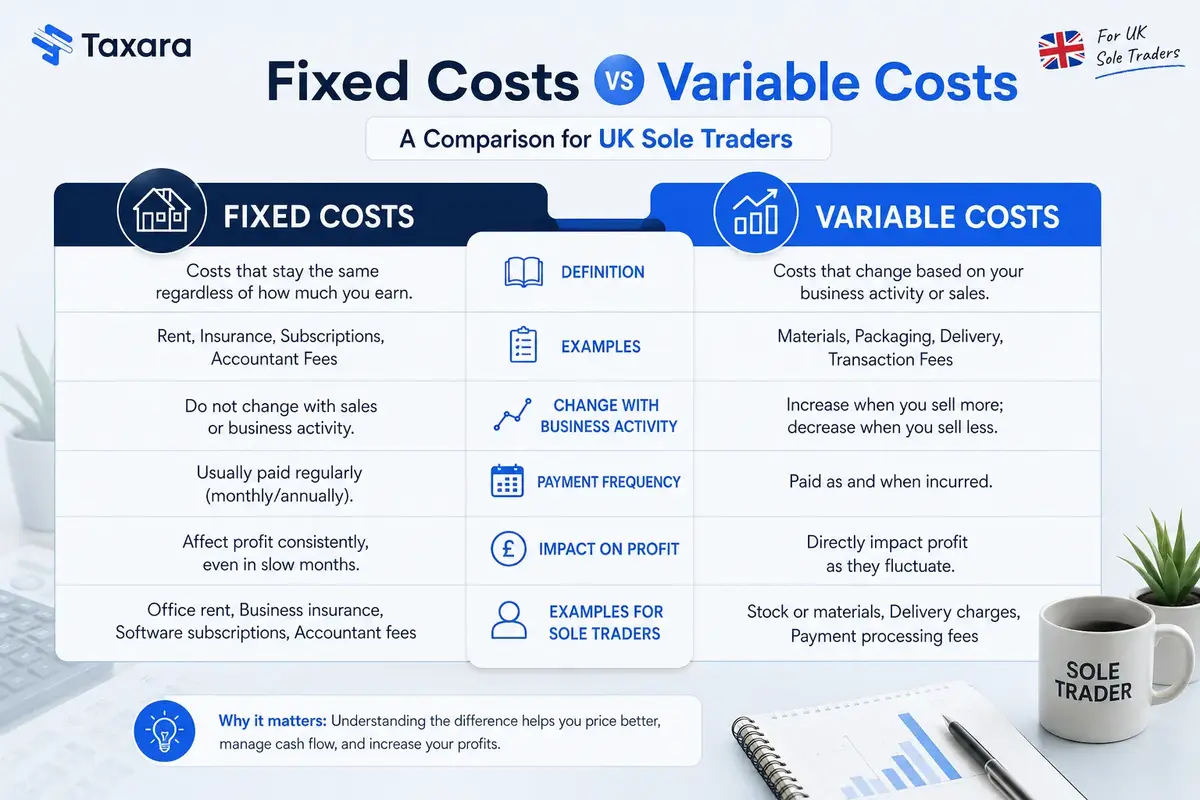
Fixed Expenses Variable Expenses Rent Stock and materials Insurance Fuel and mileage Software subscriptions Subcontractor fees Loan repayments Card processing fees Accountant retainer Seasonal marketing spend
There's also a middle category worth knowing: semi-variable expenses. These have a fixed base cost plus a variable part on top. A phone contract is a good example. You pay a fixed line fee every month, plus extra if you go over your data.
Before we get into the maths, it's worth knowing your other filing dates too, since variable expenses are just one part of running an organised business. Our self employed checklist covers registration steps and deadlines in one place, so nothing catches you out later in the year.
How to Calculate Variable Expenses (2 Simple Methods)
There are two ways to work out your variable expenses. Use whichever one fits the numbers you already have to hand.
Method 1: Cost per unit x number sold
Multiply your cost per unit by how many units you sold or made.
Variable cost = cost per unit x units sold
Example: Amara runs a small online candle business from home. Each candle costs her £3.20 in wax, wicks, and packaging. In July, she sold 140 candles.
£3.20 x 140 = £448 in variable costs for July.
Method 2: Total costs minus fixed costs
Subtract your fixed costs from your total monthly costs.
Variable cost = total costs − fixed costs
Example: Tom is a freelance graphic designer. In June, his total business costs were £890. His fixed costs, software subscriptions, insurance, and a coworking desk, added up to £310.
£890 − £310 = £580 in variable costs for June. That £580 covered things like stock images, printing for a client project, and mileage to two client meetings.
How Taxara Makes This Easier
Doing this by hand every month is the main reason most sole traders give up on tracking variable costs after a few weeks.
Taxara sorts your expenses automatically, so you can see fixed and variable costs separately without doing the maths yourself every month.
You can try Taxara free and see your own numbers laid out this way in a few minutes. No spreadsheet required, and nothing to set up before you can see it working for your own business.
Why Sole Traders Should Track Variable Expenses
Method 1 works best for a product business, a caterer charging per head, or a tutor charging per session, since the cost scales directly with units. Method 2 suits most service based sole traders, since their costs are harder to tie to a single unit. Whichever one you use, track the number every month rather than just once. A single month tells you very little on its own, but three or four side by side shows you the real pattern.
Tracking variable expenses does two jobs at once. It helps you budget month to month, and it feeds directly into your Self Assessment tax return.
Every allowable business expense you claim lowers your taxable profit, which lowers your tax bill. If you're not tracking variable costs as they happen, you'll likely forget some of them by the time your tax return is due. That means paying more tax than you actually need to.
There are two ways to claim expenses on your return. Simplified expenses use a flat rate HMRC sets for things like mileage and working from home. Actual costs mean you record and claim exactly what you spent. If you use actual costs, tracking variable expenses properly isn't optional. It's the only way to get an accurate number for your return.
From April 2026, Making Tax Digital for Income Tax also means many sole traders need to keep digital records anyway. If you're already tracking expenses digitally, you're ahead of that requirement rather than scrambling to catch up later in the year. Variable expenses are usually the hardest part of this to keep on top of, simply because there are more of them and they arrive at random times, not on a fixed schedule you can plan around.
How Often Should You Calculate Variable Expenses?
Monthly is the sweet spot for most sole traders. Weekly is too much admin for most people to keep up with long term, and yearly is too late to catch problems while they're still small and easy to fix.
A simple routine that works for most businesses:
- Log each variable cost as it happens, even a quick note on your phone is enough for now
- At the end of the month, add them all up using either method above
- Every quarter, compare the four numbers side by side and look for a pattern
This routine takes a few minutes a week, and it means you're never starting from zero when tax season arrives. It also gives you an early warning if costs are creeping up faster than your income, which is easy to miss when you're focused on the work itself rather than the numbers behind it.
Putting It All Together: A Full Month Example
Here's how both methods look side by side for one business, so you can see they lead to the same place.
Priya is a self employed tutor. In August, she taught 60 sessions and charged £2 per session in printed worksheets and travel between homes. That's her Method 1 number: £2 x 60 = £120 in variable costs.
She also knows her total spend for the month was £510, and her fixed costs, a laptop subscription and public liability insurance, came to £390. That's her Method 2 number: £510 − £390 = £120.
Both methods land on the same £120, which is exactly what you'd expect. If your two numbers don't match when you try this yourself, it usually means a cost has been counted twice, or left out of one of the calculations. Going back through your list line by line will usually show you where the gap is.
Priya now has a clear monthly figure to compare going forward. If next month's variable costs jump to £200 without more sessions to explain it, that's a signal worth looking into, rather than something to notice for the first time at tax return season.
Common Mistakes to Avoid
A few mistakes come up again and again when sole traders start tracking variable expenses.
Mixing variable and fixed costs together. If everything sits in one lump sum, you can't see which part of your spending actually moves with your workload. Keep them separate from the start, even if it feels like extra admin at first.
Only checking once a year. By the time your tax return is due, half the receipts are gone and the details are fuzzy. Monthly tracking avoids this entirely, and it takes far less time than trying to reconstruct twelve months in one sitting.
Forgetting small, irregular costs. A one-off delivery charge or a single subcontractor invoice feels too small to bother with, but these add up fast across a year and they're still fully claimable. Costs come in from different places, a fuel receipt here, a supplier invoice there, and by month end half of them are forgotten or misfiled somewhere.
Not separating business and personal spending. If your business costs run through a personal account, variable expenses get buried among everything else. A dedicated business account makes this far easier to untangle later on.
Sources
For official guidance on what counts as an allowable expense, see GOV.UK's page on self-employed expenses. This is the first place to check whenever you're unsure if a cost qualifies, and it's updated whenever the rules change, so it's worth bookmarking rather than relying on memory from a previous tax year. If you decide to use the flat rate method instead of tracking actual costs, HMRC publishes separate guidance on simplified expenses, which is worth reading alongside this guide before you choose between the two claim methods.
Never stress again
Never be late again
Never waste time
.png)


On time.
In shape.
Taxara keeps your finances in shape and always on time - with just a few simple taps and clicks.
Try for free
Simple.
Affordable.
Taxara comes with a free plan, and the premium one starts from £6.99 - about the same as your daily coffee.
Try for free
Your time.
All yours.
Win back your time and focus on what you love most - let Taxara’s AI take care of the rest.
Try for freeGot questions?

Save time for what matters most - with Taxara
Taxara Ltd. 273/275 Wilmslow Road, Manchester, England
info@taxara.co.uk
support@taxara.co.uk
.png)
.png)
.png)


.png)